Technology Partner Case Study

Rocsole gives a mature-field operator a clear view of oil, emulsion, and water through EOR treatment, the platform behind EnerCorp’s LiquiDetect

Location: Onshore mature oil field, Middle East

The Problem

This operator was running a polymer-flood Enhanced Oil Recovery (EOR) program and wanted to take it to the full field. Before they could, they had to understand how the back-produced EOR fluids were affecting oil-water separation, and they had no reliable way to measure it. EOR chemicals shift the density of the oil and emulsion, and when those densities converge the interface between them nearly disappears.

The instrumentation they had could not keep up:

  • Bullet Point Icon
    A differential-pressure level control device that could not tell the oil, emulsion, and water interfaces apart, especially during the first flowback from the wells
  • Bullet Point Icon
    Almost no density contrast between the oil and emulsion layers, which left conventional control effectively blind to where one fluid ended and the next began
The stakes were concrete. Oil-in-water had to stay within environmental limits and Basic Sediment & Water (BS&W) within the agreed range. Misreading the interface meant water exported with the oil, off-spec quality, longer retention times, and lower throughput, with unknown bottlenecks quietly capping production.

The Solution

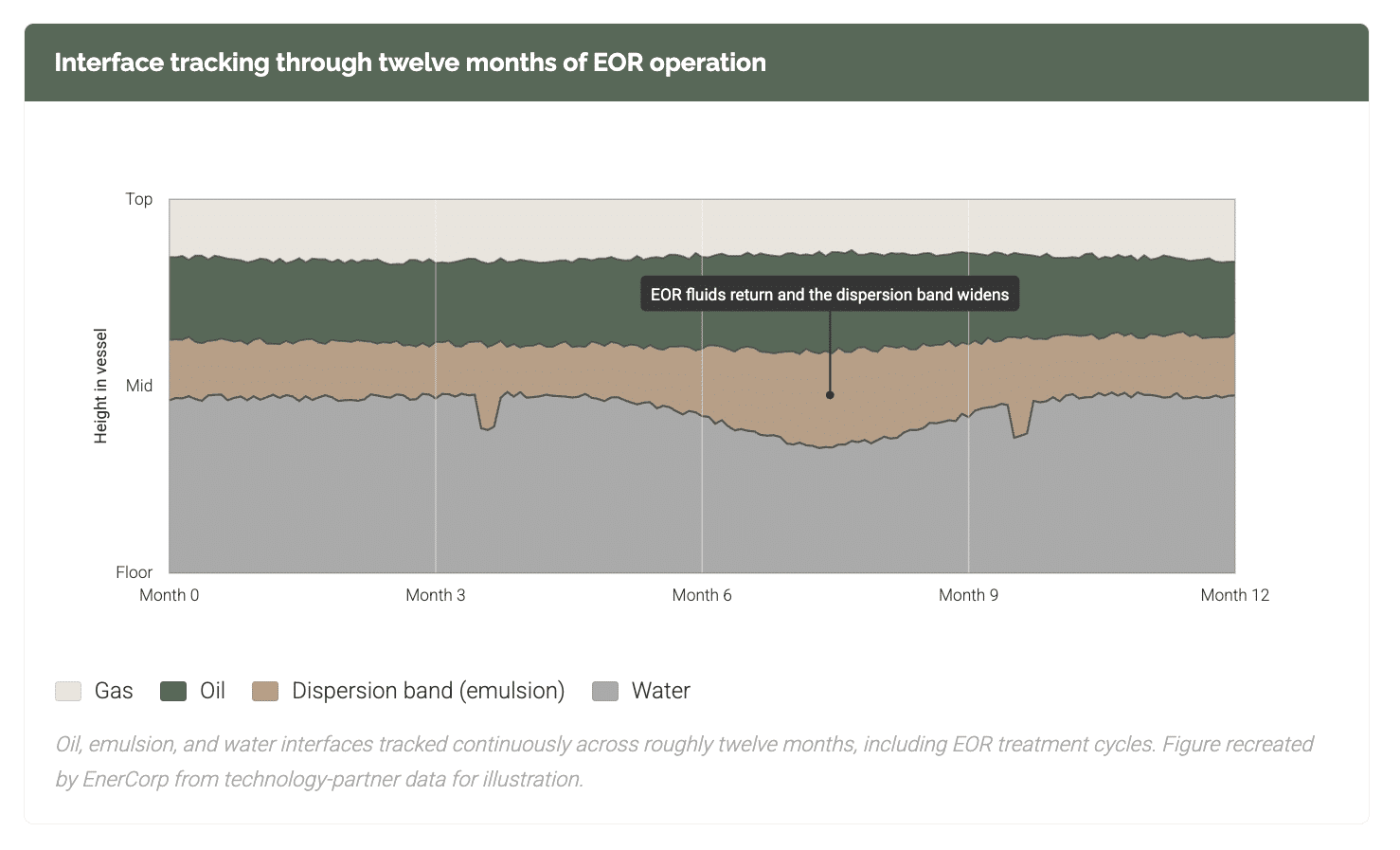
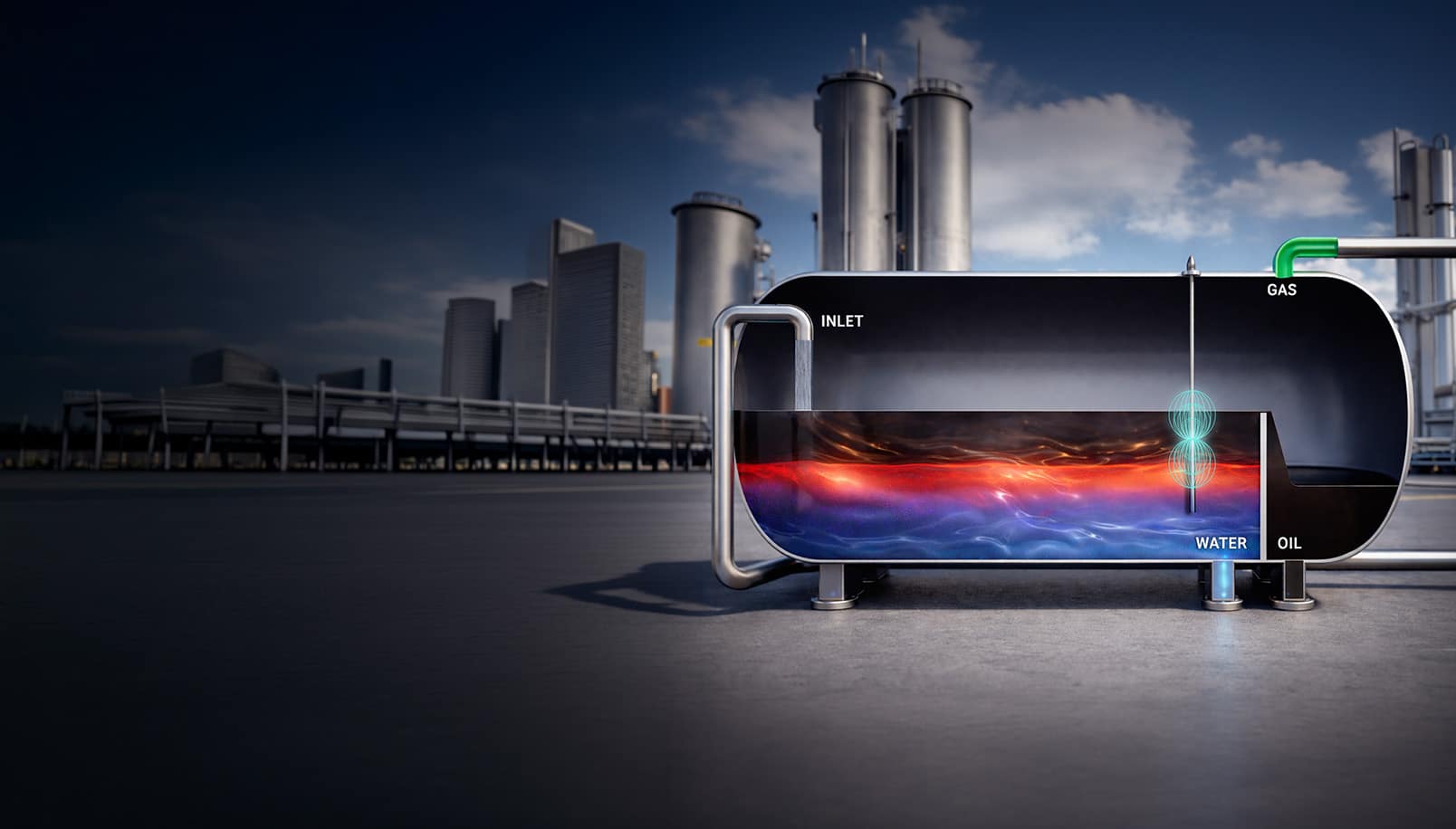
After reviewing the available technologies, the operator selected Rocsole’s Electrical Tomography Technology based LiquiDetect solution. The sensor was sized to cover the full emulsion separation zone inside the vessel and installed through an existing top nozzle, so the separator stayed in service. Rather than reading a single point and inferring the rest, the system profiled the full height of the vessel continuously for roughly twelve months, resolving the oil, emulsion, and water interfaces the entire time, including through the EOR treatment cycles that defeated the existing control.
LiquiDetect, powered by Rocsole’s electrical tomography, sees the oil, emulsion, and water inside the vessel even when the density contrast between layers all but disappears, exactly the condition that blinds conventional level control.
EnerCorp brings this same platform to North American operators as LiquiDetect, the non-nuclear way to see what is happening inside a separator in real time.
Image

The Results

Over roughly twelve months, the system continuously resolved the oil, emulsion, and water interfaces through the EOR treatment cycles, including a reverse emulsion the existing control could not see, and its accuracy was confirmed against independent surveillance monitoring and lab sampling.

The visibility did more than track levels. Early data flagged a turbulent zone inside the vessel that looked like a mix of foam and emulsion. Reviewed alongside the design and production data, it turned out a large volume of gas was overloading the inlet device and driving foam into the liquids, an operational problem the operator had no way to see before. Separately, analysis of the dispersion-band height combined with production data exposed a fault in the chemical-treatment equipment that operators had not detected.
Image
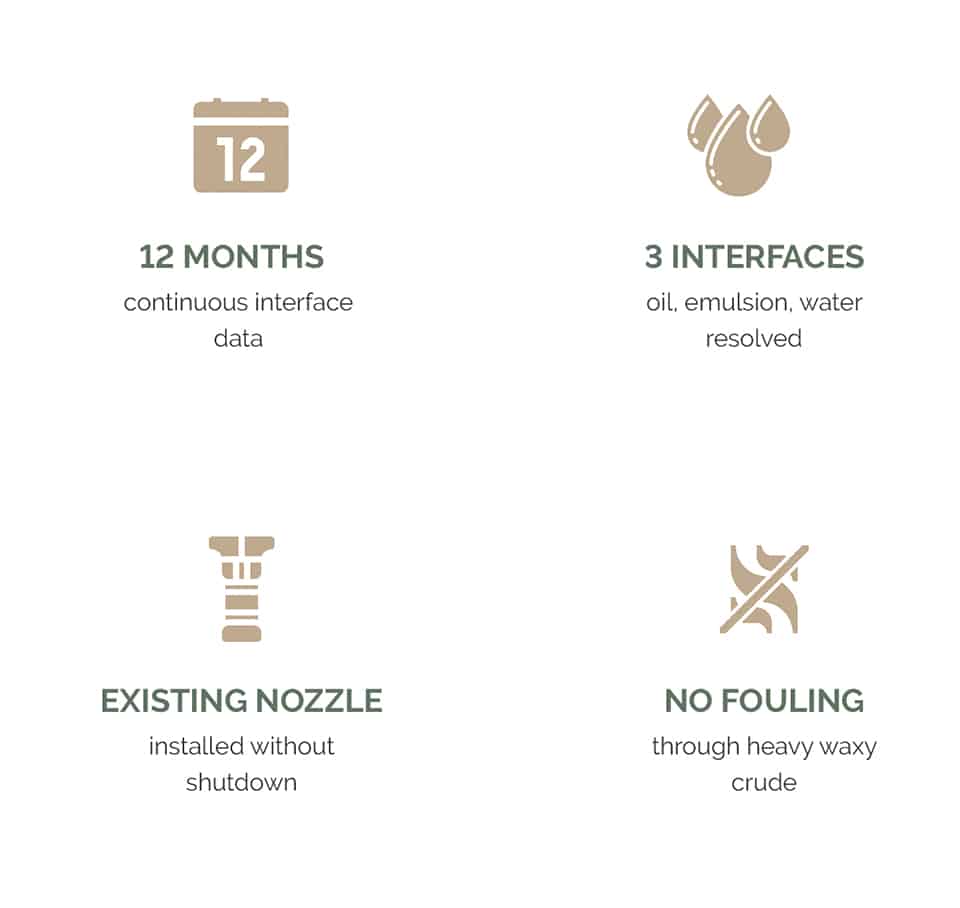
The system also captured interface spikes that the existing differential-pressure control missed entirely, and it held up through heavy waxy crude with no observable fouling. The operator gained the understanding needed to scale EOR across the full field, and reported a meaningful CAPEX advantage and an HSE benefit over the alternative approach they had considered.
Through LiquiDetect, operators can:
  • Bullet Point Icon
    Catch emulsion before it costs them by seeing emulsion presence and severity in real time, instead of finding out downstream when oil quality or water disposal numbers slip.
  • Bullet Point Icon
    Right-size chemical treatment by knowing when de-emulsifier is actually needed rather than running pumps at default settings around the clock.
  • Bullet Point Icon
    Replace level instruments they no longer trust, including differential-pressure and guided wave radar devices that cannot resolve an emulsion layer when densities converge.
  • Bullet Point Icon
    See the full vessel, not a single point, with a continuous profile of oil, emulsion, and water, using conductivity and permittivity measurements to distinguish fluid layers rather than relying on a single fixed measurement point.
  • Bullet Point Icon
    Read through contamination and coating, LiquiDetect does not rely on a single-point or surface-based measurement principle. Its Electrical Tomography approach captures distributed process data, making it less sensitive to localized contamination, wax or coating effects compared to conventional technologies.
Image
EXPERIENCE MATTERS

More EnerCorp Case Studies


Rocsole gives a mature-field operator a clear view of oil, emulsion, and water through EOR treatment, the platform behind EnerCorp’s LiquiDetect


Technology Partner Case Study Rocsole gives a mature-field operator a clear view of oil, emulsion, and water through EOR treatment,...

view the case study


Rocsole gives a mature-field operator real-time control of emulsion and produced-water quality in a high-pressure separator, the platform behind EnerCorp’s LiquiDetect


Technology Partner Case Study Rocsole gives a mature-field operator real-time control of emulsion and produced-water quality in a high-pressure separator,...

view the case study


EnerCorp Replaces Ineffective Competitor with the Sahara Advanced Sand Cyclone for Improved Performance


SAHARA CASE STUDY EnerCorp Replaces Ineffective Competitor with the Sahara Advanced Sand Cyclone for Improved PerformanceShare this PostLocation: PermianTHE PROBLEM...

view the case study


EnerCorp’s Quick Service Enables Operator to Remain Ahead of Schedule


Sahara Case Study EnerCorp’s Quick Service Enables Operator to Remain Ahead of ScheduleLocation: The PermianThe Problem An operator in the...

view the case study


Eagle Ford Operator Reduces Equipment Footprint by 66% with the Sahara Advanced Sand Cyclone


SAHARA CASE STUDY Eagle Ford Operator Reduces Equipment Footprint by 66% with the Sahara Advanced Sand CycloneShare this PostLocation: South...

view the case study


New EnerCorp Customer Captures 100% of Sand with the Sahara Advanced Sand Cyclone


Sahara Advanced Sand Cyclone Case Study New EnerCorp Customer Captures 100% of Sand with the Sahara Advanced Sand CycloneLocation: PermianThe...

view the case study

See all case studies